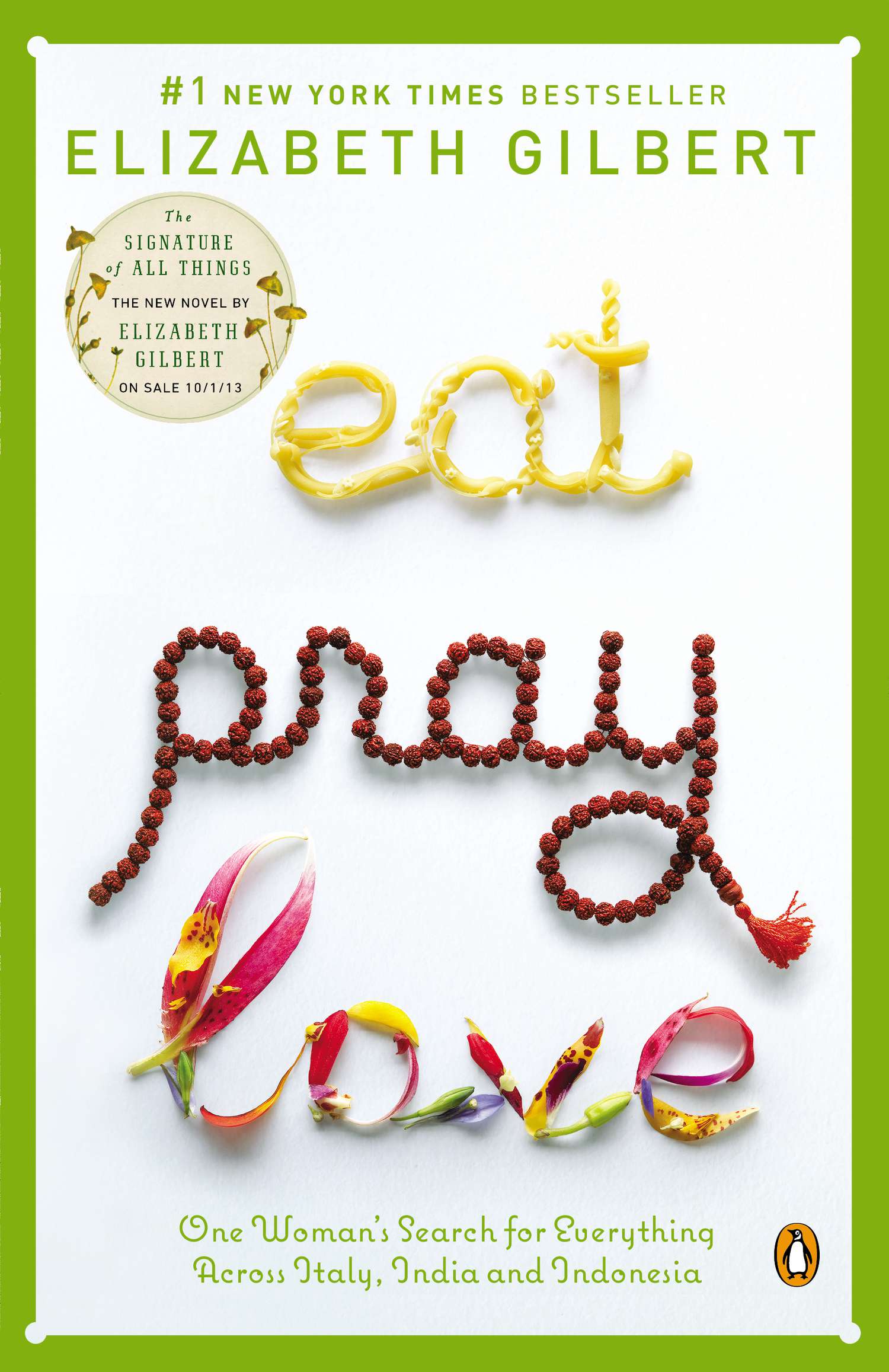
Published in 2006, Eat Pray Love is Elizabeth Gilbert's memoir of self-discovery that was adapted into a 2010 film starring Julia Roberts.
Elizabeth Gilbert is unsatisfied in her privileged life. Her marriage has crumbled and she is depressed. After a difficult divorce, she embarks on a journey to Italy, India, and Indonesia. In Italy, she finds pleasure and happiness in eating. In India, she finds God (and herself) through prayer. Finally, in Indonesia, she finds a balance between pleasure and spirituality through love.
Gilbert is a good writer. She has a style that I cannot characterize, mainly because it changes with location, but what does not change is her cleverness and humor.
The best parts of the story are the author's descriptions of Italy, India, Indonesia, and her friends. Gilbert never skimps on details and I actually liked her friends better than her.
The author is somewhat unlikable. She was an Upper East Sider who owned two houses and had a great job. Her marriage turned problematic and she cried a lot over it. Then she met this vibrant and young guy who she dated on and off and then she cried some more. Bottom line, she is whiny. She visited three exotic, interesting, and in some places, impoverished countries and only focused on herself. Her selfish exploration left me disappointed; there were few insights to draw on in my own life.
I didn't like the "ME ME ME" tone polluting the beauty of the places she visited; one and a half out of five stars.
 Lesser known than other George Orwell classics like 1984 and Animal Farm, Down and Out in Paris and London was his first published book (1933).
George Orwell is destitute and living in Paris. He sleeps at a bug-infested inn and pawns his clothes for a meager amount. Starving and alone, he reunites with his friend Boris and, luckily, they get jobs as plongeurs at a filthy Paris restaurant.
Just when things start looking up for Orwell, he quits his job (because of the twenty hour days without breaks) and moves back to England. There, Orwell is among the poorest of the poor and spends his nights at "spikes", crowded lodging houses where poor men pay a very small amount of money for a rock-hard bed, tea, and bread. In and out of the spikes, Orwell befriends interesting characters and continues to live in poverty.
Orwell likes to rant. This may be the only time I genuinely felt that a writer's rants were important, not annoying. A memorable one was his dedication of a chapter to the evolution of curse words and his feelings about them. This is important because it keeps the history of those words alive; it was also interesting to read about who used the words and how their popularity died out. The frustrating part was that, in the modern American edition I read (Harcourt), three quarters of the curses Orwell used were censored.
The best part of the story was Orwell's short dictionary of poor men's lingo. This included words like "clodhopper" (street dancer) and "shackles" (soup). By defining the lingo for us, Orwell greatly enhances our feel for the period.
The descriptions of poverty and filth are gut-wrenching. Orwell vividly describes the awful conditions the poor men lived under, the lack of hygiene and sanitation in the spikes and the Paris kitchen, and the feelings of ennui and hunger that he and the other men endured. Orwell never shies away from sharing the details of poverty.
This book has only one major negative: its blatant anti-Semitism. Every description of a Jew is defamatory and offensive. While Orwell's attitudes towards Jews may have changed later, it is still unpleasant to hear him wanting to "flatten the rich Jewish pawn shopkeeper's nose." For me, this lowers the quality of the man, not the work.
Orwell's overall message is clear: the poor are human beings who should not be seen or treated as swine. This message is still relevant today because, as a society, we often treat the poor and homeless as beneath us. Five out of five stars for Down and Out.
 Lucy Knisley is an American comic artist and musician. Relish is her second book of three.
Lucy Knisley has spent all of her 29 years around chefs and gourmet food. Relish is the memoir of all her food experiences, written in her hand and illustrated in comic-book style.
This book has much to offer the reader. First, it offers recipes, not just plain old recipes but ones with a story. Knisley must have written and illustrated at least twenty different recipes, all of which I plan to try out (I've already tried the excellent chai tea).
The second gift of this book is the sources of the amazing foods that Lucy describes. This is really useful because, like Lucy, I travel a lot and I am looking forward to trying the places she has visited.
Thirdly, this memoir contains the greatest descriptions of food I have ever read. They're sense-provoking and accompany the illustrations perfectly.
Finally, at the back of the book, there is an entertaining miniature photo album with pictures of her and her family in the kitchen. This gave the book a sense of genuineness and it was interesting to see the influences behind her culinary adventures.
Lucy's illustrations of New York, Chicago, Italy, Japan, and Mexico are accurate and creative. Her descriptions of international foods are the best parts of the memoir.
This book is a great read for the cook or the passionate eater because it will inspire ambitious cooking, eating, and traveling. Five out of five stars.
I would like to wish all my readers a very happy and healthy new year.
 The Principles of Uncertainty is a book by the noted children's book illustrator, Maira Kalman, who has in the past drawn covers for The New Yorker.
The Principles is Kalman's memoir of "everything that is in her heart." Her heart is filled with tales of travel, possessions, people, and other interesting things. She shares her thoughts by writing and drawing them.
This book is unique. On each of the book's 325 pages, there is a hand-drawn picture or photograph accompanied by few or no words. In this case, a picture is really worth a thousand words. Just by looking at a picture, I really understood what she was thinking in her reminiscence. Usually, I don't read heavily illustrated books but this was a great change of pace from my steady diet of prose.
The drawings in this book are phenomenal. The detailed and colorful miniatures contribute much to the story and put a whimsical spin on Kalman's memoir. The comments are in her hand in script. You can see her thought process and where she made changes and crossed words out. I had never seen that before and it was creative.
The best parts of this book are Kalman's drawings and her observations about life which are honest and relatable. A solid five out of five stars.