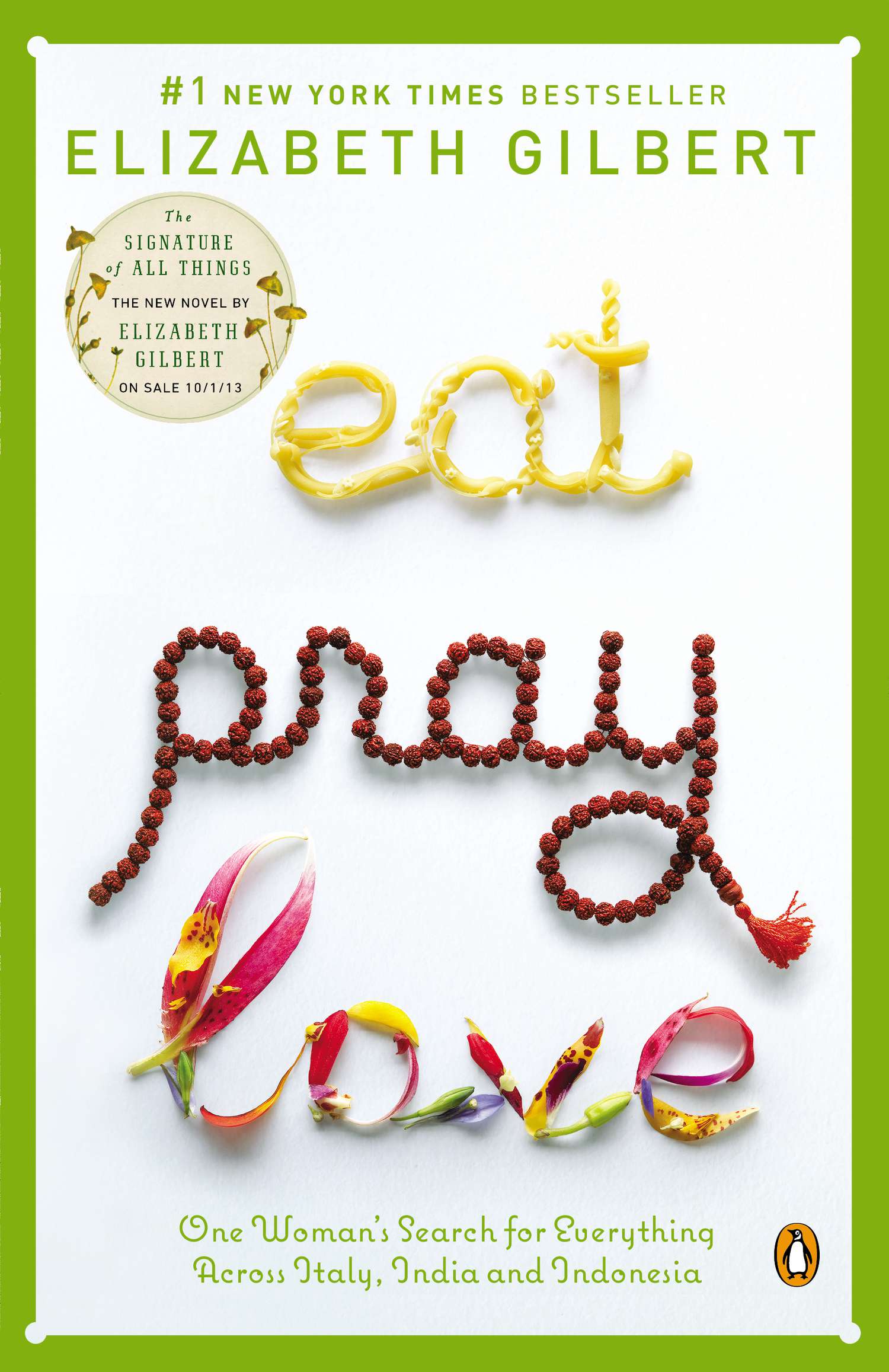
Published in 2006, Eat Pray Love is Elizabeth Gilbert's memoir of self-discovery that was adapted into a 2010 film starring Julia Roberts.
Elizabeth Gilbert is unsatisfied in her privileged life. Her marriage has crumbled and she is depressed. After a difficult divorce, she embarks on a journey to Italy, India, and Indonesia. In Italy, she finds pleasure and happiness in eating. In India, she finds God (and herself) through prayer. Finally, in Indonesia, she finds a balance between pleasure and spirituality through love.
Gilbert is a good writer. She has a style that I cannot characterize, mainly because it changes with location, but what does not change is her cleverness and humor.
The best parts of the story are the author's descriptions of Italy, India, Indonesia, and her friends. Gilbert never skimps on details and I actually liked her friends better than her.
The author is somewhat unlikable. She was an Upper East Sider who owned two houses and had a great job. Her marriage turned problematic and she cried a lot over it. Then she met this vibrant and young guy who she dated on and off and then she cried some more. Bottom line, she is whiny. She visited three exotic, interesting, and in some places, impoverished countries and only focused on herself. Her selfish exploration left me disappointed; there were few insights to draw on in my own life.
I didn't like the "ME ME ME" tone polluting the beauty of the places she visited; one and a half out of five stars.
First published in 1886, The Strange Case of Dr Jekyll and Mr Hyde is one of Robert Louis Stevenson's most famous works.
Gabriel Utterson is the executor of Dr Henry Jekyll's will. In his will, Jekyll has bequeathed his assets to his friend, Edward Hyde. While walking with another lawyer, Utterson hears of a despicable act carried out by Hyde. Utterson investigates further.
I didn't include spoilers in my plot summary but the ubiquitous references to it in pop culture will probably have ruined it for you anyway. If this were the Victorian Era, the ending would be shocking. Since we all know he ending, the climax is not exciting.
I will tell you that Jekyll represents good and Hyde represents evil, making them foils. However, there are not enough good acts to establish Jekyll as good, and Hyde's crimes aren't that evil. I wish there were more support for the characters' personalities.
The last chapter sums up the mystery in a letter written by Jekyll. The novella ends with the letter. It would make sense to have some closure and reactions after the mystery is solved. Truly, though, this doesn't bother me, because I was not invested in Stevenson's underdeveloped characters.
Stevenson's writing is straightforward but disconnected and dry, making this an unenjoyable read.
Overall, I liked the theme (which I can't reveal) of Jekyll and Hyde, but many elements of the work are half-baked. I rate this book two out of five stars.
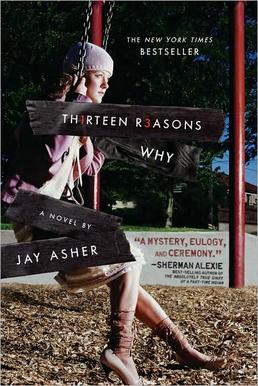
 Thirteen Reasons Why (2007) is regarded as a YA fiction jewel and is Jay Asher's first novel.
Clay Jensen is a high schooler whose classmate, Hannah Baker, has recently killed herself. Clay mysteriously receives a package of cassette tapes in the mail that have been narrated by Hannah. He soon learns that Hannah intended for the cassettes to be listened to by the thirteen people whose actions are the "reasons" she killed herself. Hannah has insured that each person who receives the tapes will send them to the next person "implicated" in her suicide.
Hannah's story, as told on the cassettes, appears in the book in italics, juxtaposed with Clay's reactions. Despite the font changes, it is hard to differentiate the narratives because the voices are similar. Strike one against the book.
Hannah Baker is interesting. She blames the schoolmates mentioned on her cassettes for her problems. Realistically, her problems happen to a lot of people in high school, barely any of whom kill themselves. If there were more detail about Hannah's past, and not just the events right before her suicide, it would have been easier to understand why she did it. Without knowing the background and deeper issues, it's unrealistic for her to have killed herself over a few incidents with jerks and moving to a new school. Strike two.
In the end, Clay's reactions to Hannah's suicide tale are not fully revealed to us; his only response is to approach and talk to a wallflower. The weak ending means we don't learn how all of the characters tie up their feelings for Hannah. The botched ending is strike three.
I understand Asher's message: that our actions affect everyone, so be careful about what you do and say. Great message, poorly executed.
I don't understand why this book has received such lofty praise. The writing is mediocre and there are plenty of better and more realistic books on teen suicide (Looking For Alaska, It's Kind of a Funny Story, The Bell Jar). One out of five stars.
 The Garden Party (1922) is one of Katherine Mansfield's most famous short stories.
Note: Due to the short length of this story, it's impossible not to give away the plot; consider yourself warned.
The Sheridans, a wealthy New Zealand family, are hosting a garden party. During their preparations, they learn that a working-class neighbor has died that day. In wanting to call the party off, Laura Sheridan shows her sympathy for the neighbor's family. Her sisters and her mother dismiss Laura's idea and the party begins as the guests arrive. Afterwards, Laura brings a basket of leftovers to the dead man's home and sees his body. Laura ends the story with an incomplete sentence: "Isn't life..."
To write a story of 30 pages that captures many emotions, it requires genius -- that's what Katherine Mansfield had. Laura is the only one in her family who shows sympathy for the poor neighbors; this statement about class division is profound. Laura, up until the end of the story, has confronted neither death nor poverty; all she knows is luxury, good fortune, and garden parties. I am impressed with the number of themes Mansfield tackles in such a small number of pages.
I admire Mansfield's laconic writing style. The details of the story's setting are magnificently vivid. It is the perfect day for the garden party; the sunlight shining on the garden, the fragrance and abundance of the lilies, and the just right weather. Mansfield describes the scene perfectly in a few simple words. Mansfield never actually describes her characters. We sense their personalities through their dialogue.
Overall, this story hits many high notes in a few pages -- five out of five stars.
 Lesser known than other George Orwell classics like 1984 and Animal Farm, Down and Out in Paris and London was his first published book (1933).
George Orwell is destitute and living in Paris. He sleeps at a bug-infested inn and pawns his clothes for a meager amount. Starving and alone, he reunites with his friend Boris and, luckily, they get jobs as plongeurs at a filthy Paris restaurant.
Just when things start looking up for Orwell, he quits his job (because of the twenty hour days without breaks) and moves back to England. There, Orwell is among the poorest of the poor and spends his nights at "spikes", crowded lodging houses where poor men pay a very small amount of money for a rock-hard bed, tea, and bread. In and out of the spikes, Orwell befriends interesting characters and continues to live in poverty.
Orwell likes to rant. This may be the only time I genuinely felt that a writer's rants were important, not annoying. A memorable one was his dedication of a chapter to the evolution of curse words and his feelings about them. This is important because it keeps the history of those words alive; it was also interesting to read about who used the words and how their popularity died out. The frustrating part was that, in the modern American edition I read (Harcourt), three quarters of the curses Orwell used were censored.
The best part of the story was Orwell's short dictionary of poor men's lingo. This included words like "clodhopper" (street dancer) and "shackles" (soup). By defining the lingo for us, Orwell greatly enhances our feel for the period.
The descriptions of poverty and filth are gut-wrenching. Orwell vividly describes the awful conditions the poor men lived under, the lack of hygiene and sanitation in the spikes and the Paris kitchen, and the feelings of ennui and hunger that he and the other men endured. Orwell never shies away from sharing the details of poverty.
This book has only one major negative: its blatant anti-Semitism. Every description of a Jew is defamatory and offensive. While Orwell's attitudes towards Jews may have changed later, it is still unpleasant to hear him wanting to "flatten the rich Jewish pawn shopkeeper's nose." For me, this lowers the quality of the man, not the work.
Orwell's overall message is clear: the poor are human beings who should not be seen or treated as swine. This message is still relevant today because, as a society, we often treat the poor and homeless as beneath us. Five out of five stars for Down and Out.
 Eleanor & Park is a 2013 young adult novel that has received a Michael L. Printz book honor, among many awards.
Eleanor Douglass is a red-headed, overweight high school girl who recently moved to Omaha, Nebraska. She lives an impoverished life with her mother, her four siblings, and her abusive stepfather. Park Sheridan is an Asian-American high school boy who meets Eleanor on the bus. As time goes by, Eleanor and Park bond over music and comic books and eventually end up dating, despite their different backgrounds.
The story is told by a third-person omniscient narrator who alternates the points of view of Eleanor and Park. I didn't care for this style of storytelling - if you're going to alternate points of view, let the characters narrate the story themselves in the first person.
I felt the writing wasn't very special - it lacked depth and description, which would have enhanced the book. The author focused more on Eleanor than Park and by the end of the book, I felt disappointed that there was less of his story told.
Eleanor and Park's relationship developed slowly and peaked in the last third of the story. I liked the way Rowell didn't rush it (as in most YA love stories) - this made it much more meaningful.
Eleanor and Park brings out all the feelings a good love story should; sadness, hope, heartbreak, and joy. For its meaningful love
story, I give Eleanor and Park three and a half out of five stars, despite some major flaws.
 The Grand Babylon Hotel was originally published in 1902 as a serial in The Daily Mail in London. It has since been adapted into two films of the same name.
Theodore Racksole is a New York millionaire vacationing with his daughter, Nella, in London. The Racksoles are staying at the luxurious and famous Grand Babylon Hotel. After being unable to order dinner that wasn't on the menu, Theodore impulsively purchases the hotel from the owner. Once he takes over the hotel, though, Theodore discovers a nasty conspiracy against a guest implicating members of his staff.
I throughly enjoyed the plot of this book: there were mysteries, cliffhangers, and intriguing characters. These elements kept me engaged and on the edge of my seat. That being said, I was disappointed that most of the action took place outside of the hotel. I wanted to hear more about how a hotel in the early 1900s was run.
Some of my favorite parts were the descriptions of London, and in particular, the Thames. The descriptions weren't all that imaginative, but they were nonetheless cool to read.
The writing was also not very imaginative. In fact, none of the writing was exceptional in quality or style. It's annoying that the writing wasn't better, because it would have complemented the great plot.
This book does have a few laughs, some swashbuckling moments, and loads of plot twists, but better writing would have made this a great book. Three out of five stars.